
As a Yorkshireman I do like a bargain, and here we have a buy one, get one free from Opera North. Cavalleria rusticana is only a short opera, lasting just over an hour, so it is usually twinned with another concise work, normally Pagliacci, but tonight it was given a change of partner and performed with Aleko, a piece with which I was not previously familiar, in fact I had never heard of it. I use the phrase ‘a change of partner’ deliberately because that was the premise of both works, not to mention the other opera in this season, Cosi fan tutti, which I recently reviewed. Probably not the best choice to go see during St Valentine’s week but now that that is out of the way, couples can drop the pretence and revert to type. Needless to say I live alone – can’t think why!
The subject matter is all the more surprising as the headline opera was written by Mascagni when he was a mere 25 years-old, and Aleko by Rachmaninov, when he was only 19. Who said the permissive society didn’t begin until the Swinging Sixties, these were composed in 1883 and 1890 respectively. I don’t know whether their youth was a factor, but neither of these operas was of the bonkers variety, more dark, brooding and ultimately violent. Although totally separate works by different composers, the stories are broadly similar and have been staged to intertwine. We have all seen dramas which include serial killers, but this juxtaposition, and the utilisation of the same singers in both means that we also get a serial victim.

Cavalleria rusticana tells the story of Turiddù, son of Lucia who runs the village shop. He was dating Lola, but she married Alfio, the local taxi owner. Had he listened to Copacabana by Barry Manilow, the upshot of pursuing a Lola would have been obvious and the piece would have ended there. Sadly it wouldn’t be written for another hundred years or so, so he had to find out the hard way. Anyway, Turiddù decides to take solace by seducing, or more like sexually assaulting, Santuzza, a very religious girl. He still carries a torch for Lola though, and when she gets tired of Alfio, they relight the flame.
After telling Lucia of her betrayal by her son as they prepare for Easter Mass, Santuzza confronts Turiddù about his affair with Lola, which he obviously denies, but when Lola arrives he disappears with her leaving Santuzza alone. Being a woman scorned, Santuzza tells Alfio about their partners’ shenanigans, he swears vengeance. .

After the service when people are leaving the church Turiddù challenges Alfio. Overwhelmed by guilt, Turiddù realises how badly he has hurt Alfio, Lola, Santussa and his mother from whom he asks forgiveness and gets into Alfio’s cab to meet his fate.
The opera differs in quite a few ways from others I have seen in that there are fairly long passages of music unaccompanied by singing, the bonus of which is that we get to hear the wonderful Intermezzo, one of the most beautiful pieces of music in any genre. To see what I mean click here https://soundcloud.com/opera-north/cavalleria-rusticana-intermezzo?in=opera-north/sets/cavalleria-rusticana-and-aleko If you think it sounds good it is not a patch on hearing it performed live by the amazing Orchestra of Opera North, conducted by Antony Hermus. If you leave it running you will also get to hear the Chorus of Opera North perform the Easter Hymn which is also stunning live, and well worth sticking with as you will recognise it after a minute or so.
There are only five cast members in each piece and all were at the top of their game, both in acting and singing. Soprano, Giselle Allen, sang Santuzza, a woman abused and betrayed, with mezzo-soprano, Helen Évora as Lola, the neglected wife. Robert Hayward, baritone, took the role of the hard-working cabbie, Alfio, whose absence cost him his marriage. Anne-Marie Owens, mezzo-soprano was Lucia, down-trodden shop owner and mother of the wayward Turiddù, who was sung by tenor, Andrés Presno.

The setting of the opera had been changed from 19th century Sicily to 1970s Poland where the Communist Party was still in control, witness Lucia’s shop, which was basically bereft of stock but where queues quickly formed when a few pieces of smoked sausage or bread arrived. Whilst the working class women formed an orderly line, a well-dressed couple waltzed straight to the front for their provisions, with no one turning a hair, presumably for fear of reprisals from The State, in which the miscreants were obviously highly placed. The atmosphere was also enhanced by the presence of Alfio’s Polski Fiat 126, the only taxi in town.

I found the set to be a little confusing at times as it was an open plan affair with a sitting room to the left, a church in the middle and the shop on the right. When there was a symbolic church scene, the wooden panel with the cross was brought to the front, which as fine, but it was odd when the taxi was pushed on into the shop and the living room.
Despite that last point I found Cavalleiria rusticana very enjoyable on several levels, as an action piece, a parable and a love story.
Aleko, the companion work, had also been transposed from its original setting in a Russian gypsy camp to a surf shack run as a commune in an unnamed USA state, but looking very Californian.
An old man is telling a story about how, many years before, he loved a woman who left him for another man, leaving behind their infant daughter, Zemfira. She is now grown up and married to Aleko, a man who has joined their community from outside.

Aleko cannot understand why the old man didn’t take revenge, but Zemfira gets it because, just like her mother, and the rest of the surfer dudes, she believes that love must be free. Frustrated by Aleppo’s possessiveness, she is drawn to a younger man in the commune. We all know where this is going, even without a Lola being involved.
Tensions between Aleko and Zemfira escalate, causing him to become increasingly disturbed and, alone one night, he recalls how a once passionate love has gone cold.
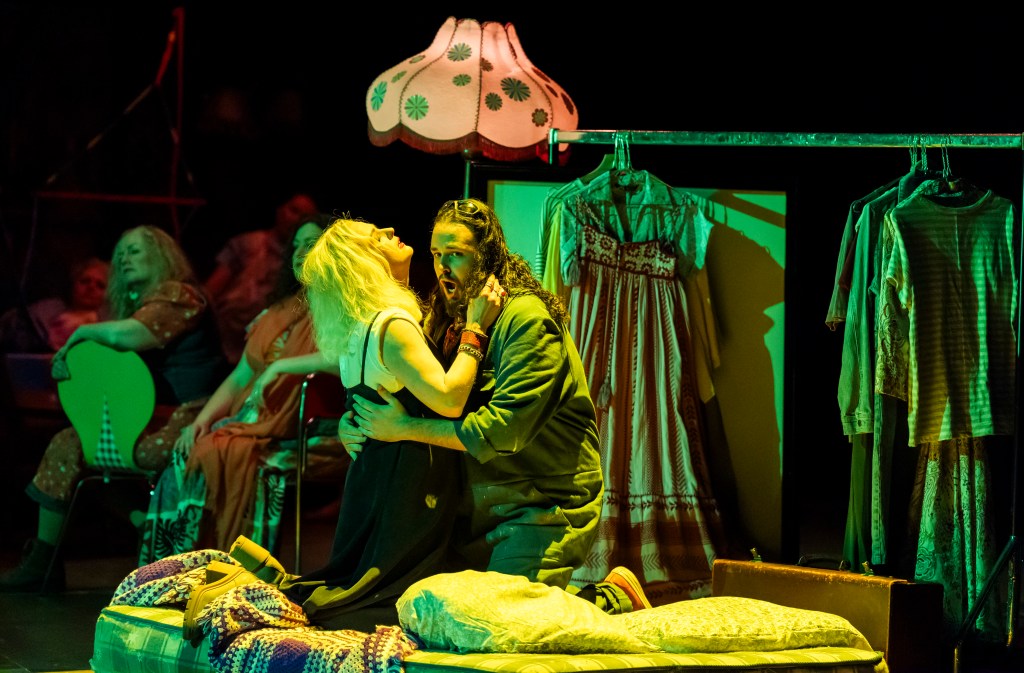
The following morning he sees Zemfira and her young lover together and, in a fit of rage kills them both. Led by her father, the old man, literally, the community spares Aleko but banishes him forever.
As I have said before, some of the cast appear in both operas, and here we find Robert Haywood, as Aleko and Andrés Presno as the young lover of Zemfira, sung by the soprano, Elin Pritchard. Once again echoing a previous observation, this means that the serial killer, Robert Hayward has shot dead Mr Presno twice in one night. Try explaining that to the judge!

The other cast members in Aleko were Anne-Marie Owens, another multi-tasker, and bass-baritone, Matthew Stiff as the old man, Zemfira’s father, who was every inch the aging hippy with long blond hair and beard, constantly enjoying a spliff the size of a rolled up carpet. Far out, man.

Aleko was a much livelier affair, literally, and featured the Chorus of Opera North as the surfer commune. It was great to see some of the familiar faces who are normally dressed to impress, resplendent in loud shirts and dayglo beachwear, letting it all hang out. They were also called upon to throw a few shapes in one of the early arias where the dance moves saw the male choristers dancing in competition with their female counterparts in a face to face showdown reminiscent of the Sharks and the Jets in West Side Story. Somewhat of a challenge for Chorus Master, Anthony Kraus.
Both operas were imaginatively directed by Karolina Sofulak.
Although the names were different in Aleko it could quite easily have been a sequel to Cavalleria rusticana to show how history has a habit of repeating itself. Perhaps Copacabana was written as part three, set north of Havana.
Cavalleria rusticana and Aleko are at Leeds Grand Theatre on various dates until Saturday, 24th February when they go on tour to Theatre Royal, Nottingham, Theatre Royal, Newcastle and The Lowry, Salford Quays.
For more details and bookings please go to https://www.operanorth.co.uk/whats-on/cavalleria-rusticana-aleko/
Should you be thinking of taking advantage of the Try it ON scheme for first-time opera goers then I think that you may very well enjoy this double bill. The music, especially in Cavalleria rusticana, is wonderful, and the exuberance in Aleko means that you get a varied evening’s entertainment, along with two shootings of the same bloke, by the same bloke. What’s not to love? For more details of the offer please see https://www.operanorth.co.uk/your-visit/new-to-opera/tryiton/
For details of all Opera North productions it is https://www.operanorth.co.uk/
Photographs by Tristram Kenton.

